If you own a short-term rental in Maui, you already know the feeling: another booking comes in, and somewhere in the back of your mind, a quiet panic sets in.
Did I calculate the right tax amount? Did I file on time? Am I missing something that could cost me later?
You’re not alone. Maui’s vacation rental tax rules are among the most layered in the country — and unlike most states, Hawaii requires owners to file with two separate government bodies, using a calculation method that literally taxes the tax itself.
This guide breaks down everything you need to know about Maui vacation rental taxes in 2026: what each tax is, the current rates, how to calculate what you owe, and how to stay on top of reporting without losing your mind.
Why Maui Vacation Rental Taxes Are Different
Most mainland vacation rental owners deal with one type of lodging tax. In Maui, you’re responsible for three — each with its own rate, filing schedule, and government entity.
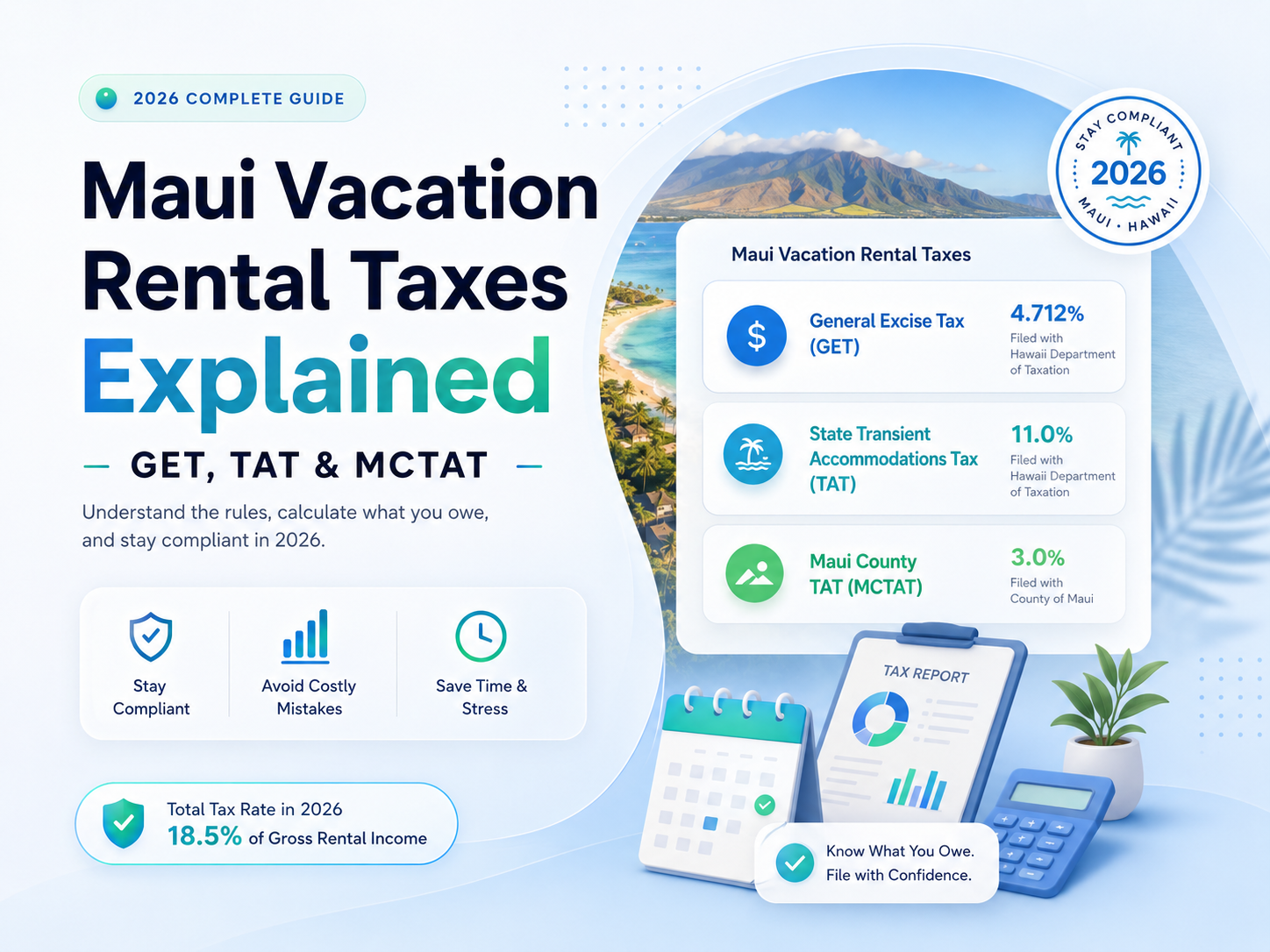
The total tax burden on a Maui short-term rental in 2026 is approximately 18.5% of gross rental income. Here’s how it breaks down:
| Tax | Rate | Filed With |
| General Excise Tax (GET) | ~4.712% (effective) | Hawaii Department of Taxation |
| State Transient Accommodations Tax (TAT) | 11.0% | Hawaii Department of Taxation |
| Maui County TAT (MCTAT) | 3.0% | County of Maui |
Understanding each one — and how they interact — is the foundation of vacation rental tax compliance in Hawaii.
The 3 Maui Vacation Rental Taxes, Explained
1. General Excise Tax (GET)
GET is Hawaii’s version of a business tax, and it applies to nearly all gross rental income — including long-term rentals, not just short-term ones.
Unlike a sales tax that gets added on top, GET is imposed on you as the business operator. The state base rate is 4%, but Maui County adds a 0.5% surcharge, bringing the effective rate to 4.712% when you account for Hawaii’s “pyramiding” method (where you end up paying tax on the tax unless you separately itemize it on guest invoices).
Key point: GET applies to every dollar of rental revenue, regardless of the length of stay.
2. Hawaii State Transient Accommodations Tax (TAT)
The TAT specifically targets short-term rentals — properties rented for fewer than 180 consecutive days. As of January 1, 2026, the state TAT rate increased from 10.25% to 11.0%, with the additional 0.75% dedicated to environmental conservation (commonly called the “Green Fee”).
This tax is filed with the Hawaii Department of Taxation, typically on a monthly or quarterly basis depending on your income level.
3. Maui County Transient Accommodations Tax (MCTAT)
The MCTAT is a 3% local surcharge on gross rental income, filed separately with Maui County — not the state. This is the piece that catches many owners off guard, especially those who assume their state filing covers everything.
The MCTAT must be filed directly with the County of Maui, on its own separate schedule. Missing this filing means you’ve filed correctly with the state and still received a county-level penalty.
The Tax-on-Tax Problem (And Why Calculation Is Tricky)
Here’s where Maui vacation rental tax rules get genuinely confusing.
If you charge a guest $1,000 in rent and don’t separately itemize your GET and TAT on the invoice, Hawaii requires you to calculate tax on the entire $1,000 — including the embedded tax amounts. This “pyramiding” effect can inflate your liability by 1–2% if you’re not accounting for it properly.
The correct approach is to itemize GET and TAT separately on each guest invoice, which allows you to calculate each tax on the base rental amount rather than on a combined total.
For a $1,000 booking, a properly separated calculation looks roughly like this:
- Base rent: $1,000
- GET (4.712%): $47.12
- State TAT (11%): $110.00
- MCTAT (3%): $30.00
- Total guest charge: $1,187.12
This is one of the biggest reasons owners who rely on informal spreadsheets end up either overcharging guests or underpaying the government.
Who Is Responsible for Filing — Even If You Use Airbnb or VRBO?
A common misconception among Maui hosts: “Airbnb collects tax on my behalf, so I don’t need to do anything.”
This is partially true — and mostly dangerous.
Airbnb and VRBO may collect and remit some taxes in Hawaii, but Hawaii law holds the property owner responsible as the ultimate filing party. Depending on your specific setup, platform remittance may not cover all three taxes, may not match your actual liability, or may create discrepancies in your own reporting.
The safest approach is to track every booking, every platform, and every tax type yourself — and reconcile with whatever the platforms report. This applies equally to direct bookings, where you bear 100% of the collection and remittance responsibility.
Vacation Rental Tax Reporting: Deadlines and Filing Frequency
Taxes on vacation rental income in Hawaii are typically filed on one of three schedules, based on your annual revenue:
| Annual Tax Liability | Filing Frequency |
| Less than $4,000/year | Annually |
| $4,000 – $96,000/year | Quarterly |
| More than $96,000/year | Monthly |
Most active Maui vacation rental owners fall into the monthly or quarterly category.
The MCTAT follows its own filing schedule set by Maui County, which may differ from the state schedule. Keeping track of two separate deadlines — for two separate government entities — is one of the primary sources of late fees and penalties for self-managing owners.
Missing a filing deadline doesn’t just mean penalties. In Hawaii, non-compliance with vacation rental tax rules can also affect your ability to renew your short-term rental permit.
Common Mistakes Maui Vacation Rental Owners Make
Even experienced hosts get tripped up by Maui’s tax structure. Here are the most frequent errors:
1. Filing state taxes but forgetting MCTAT The MCTAT is a separate county filing. Many owners correctly file GET and TAT with the state and assume they’re done — then receive a Maui County penalty notice months later.
2. Not accounting for the pyramiding effect Failing to itemize GET and TAT on guest invoices leads to inflated liability calculations. Over a full year, this can add up to hundreds of dollars in unnecessary tax payments.
3. Mixing platform bookings with direct bookings Airbnb and VRBO may remit some taxes on your behalf, but you still need to account for those amounts in your own records. Mixing them up — or double-filing — creates discrepancies that trigger audits.
4. Using mainland tax software that doesn’t understand Hawaii Most general vacation rental tax software was built for mainland tax structures. Hawaii’s GET + TAT + county surcharge system simply doesn’t fit into their frameworks. This is especially true for the pyramiding calculation.
5. Keeping records in spreadsheets Spreadsheets work — until they don’t. One formula error, one missed row, one booking that falls across a month boundary, and your numbers are off. When tax time comes, “I think the spreadsheet is right” is not a position you want to be in.
What to Look for in Vacation Rental Tax Software for Maui
If you manage your own compliance, the right vacation rental tax software makes the difference between a confident filing and a panicked one.
For Maui specifically, your tool needs to:
- Handle all three taxes — GET, TAT, and MCTAT — not just one or two
- Apply the correct pyramiding calculation so you’re neither overpaying nor underpaying
- Track bookings by source — direct, Airbnb, VRBO — and handle each correctly
- Provide monthly breakdowns so you always know what you owe before the deadline
- Support multiple properties if you manage more than one rental
- Show overdue visibility — flagging payments you might have missed
Generic tools built for mainland markets won’t meet most of these requirements. Maui’s tax structure is specific enough that it rewards using a purpose-built solution.
TATi Maui: Built Specifically for This Problem
TATi Maui is the only vacation rental tax software built exclusively for Maui STR owners. It automatically calculates GET, TAT, and MCTAT for every booking, applies the correct pyramiding method, and gives you a clean monthly dashboard showing exactly what you owe — for each property, each tax type, and each filing deadline.
Whether you manage one condo or ten properties, TATi Maui replaces your spreadsheets with a reliable, compliance-ready workflow that takes minutes to set up.
What you get:
- Automatic tax calculations for all three Maui taxes
- Multi-property tracking under one login
- Monthly snapshots with clear totals and due dates
- Overdue visibility so nothing falls through the cracks
- Support for direct bookings, Airbnb, and VRBO
Start your 14-day free trial — no credit card required until your trial ends.
→ Start Free Trial at TATi Maui
Frequently Asked Questions
What is the Hawaii vacation rental tax rate in 2026?
The combined effective tax rate for a Maui vacation rental in 2026 is approximately 18.5%: 4.712% GET + 11% state TAT + 3% MCTAT.
Does Airbnb pay my Maui vacation rental taxes for me?
Airbnb may remit some taxes, but Hawaii law makes the property owner ultimately responsible for filing. You should always track your own numbers and verify what platforms remit on your behalf.
What is the difference between TAT and MCTAT?
The TAT is a Hawaii state tax filed with the Department of Taxation. The MCTAT is a Maui County tax filed separately with the County of Maui. Both apply to short-term rentals, and both must be filed independently.
How often do I need to file vacation rental taxes in Maui?
Filing frequency depends on your annual tax liability — annually, quarterly, or monthly. Most active vacation rental owners file monthly or quarterly.
What happens if I miss a Maui vacation rental tax deadline?
Late filings result in penalties and interest. Repeated non-compliance can also affect your short-term rental permit renewal.
Managing your Maui vacation rental taxes doesn’t have to be stressful. TATi Maui was built to take this exact burden off your plate — automatically, accurately, and every single month.