You list your Maui condo on Airbnb. Guests book. Airbnb collects payment and deposits your payout. Somewhere in that transaction, taxes happen — and Airbnb sends a note saying it has “collected and remitted” occupancy taxes on your behalf.
So you’re covered, right?
Not exactly.
This is the most dangerous assumption Maui vacation rental hosts make — and it costs them real money when the Hawaii Department of Taxation or Maui County comes looking for filings that were never made.
This guide breaks down exactly how Airbnb and VRBO handle taxes in Hawaii, what the difference is between the two platforms, what neither platform covers, and what you — the property owner — are still legally responsible for.
Why Maui Is Different From Every Other Market
Before comparing Airbnb and VRBO, you need to understand why this question matters so much more in Maui than it does in, say, Phoenix or Nashville.
Most U.S. vacation rental markets have one lodging tax — a single occupancy or transient tax collected at a single rate, remitted to one entity. When Airbnb says it “collects and remits” taxes in those markets, the statement is relatively complete.
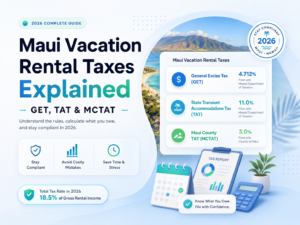
Maui has three separate taxes, filed with two separate government entities, using a calculation method that doesn’t match how mainland platforms are built:
| Tax | Rate | Filed With |
| General Excise Tax (GET) | 4.712% effective | Hawaii Dept. of Taxation |
| State Transient Accommodations Tax (TAT) | 11.0% | Hawaii Dept. of Taxation |
| Maui County TAT (MCTAT) | 3.0% | County of Maui |
Total combined rate: ~18.5%
Neither Airbnb nor VRBO was built for this structure. Their tax remittance frameworks were designed around simple single-rate lodging tax systems. When you layer Hawaii’s pyramiding GET calculation and Maui’s separate county filing on top, gaps appear — gaps that the owner is legally required to fill.
What Airbnb Actually Collects and Remits in Hawaii
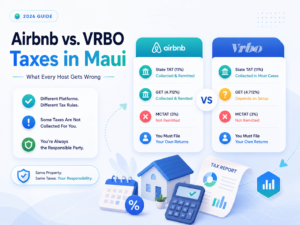
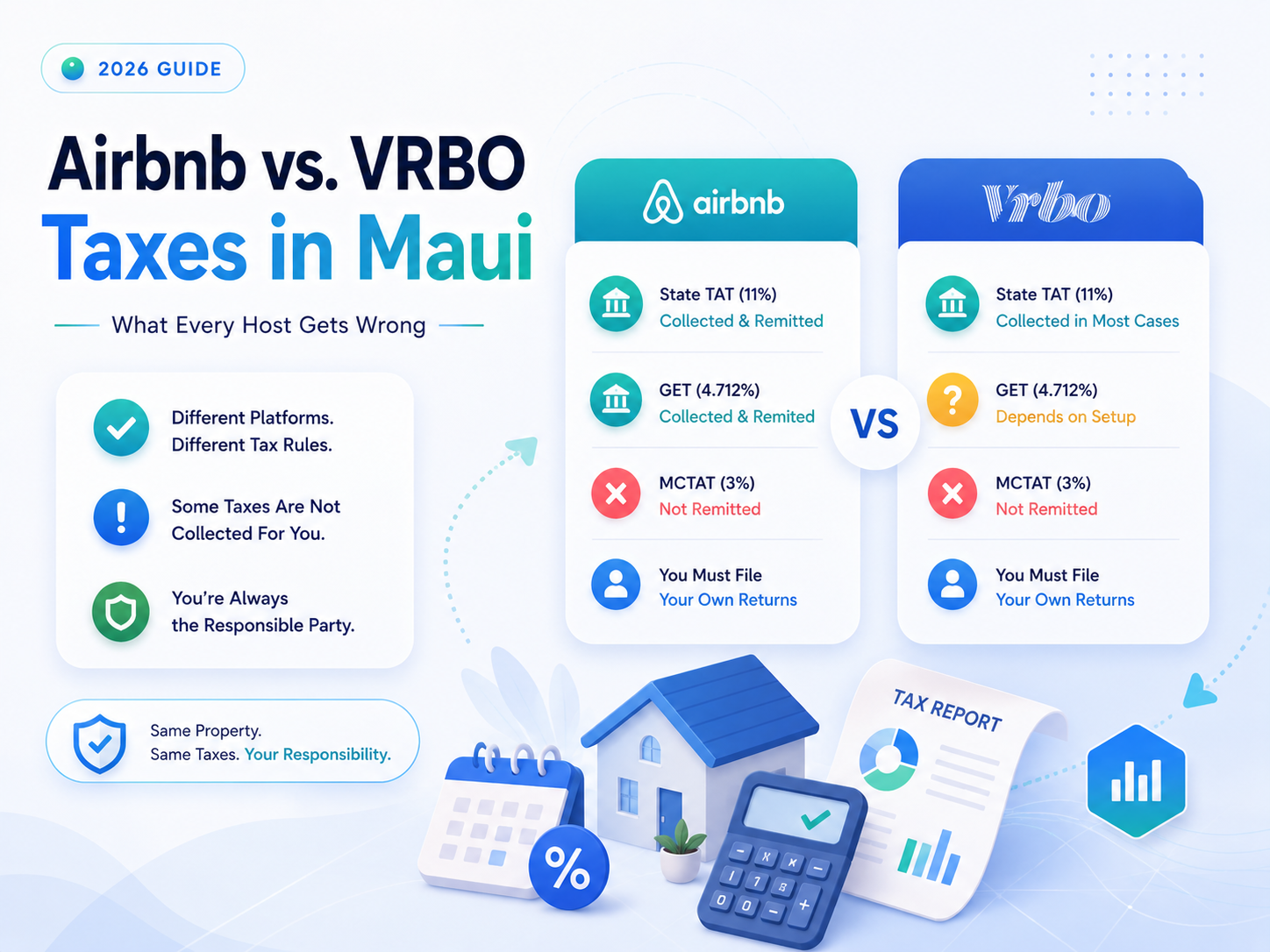
Airbnb has a tax collection agreement with the State of Hawaii. Under this agreement, Airbnb collects and remits:
- Hawaii State Transient Accommodations Tax (TAT) — yes, Airbnb handles this for bookings made through its platform
- General Excise Tax (GET) — Airbnb collects and remits GET on the accommodation portion of the booking
This sounds comprehensive. Here’s where it breaks down for Maui hosts:
1. Airbnb Does Not Remit MCTAT on Your Behalf
The Maui County Transient Accommodations Tax (MCTAT) is a county-level tax filed directly with the County of Maui — not the state. As of 2026, Airbnb’s remittance agreement covers state taxes. The MCTAT responsibility remains with the property owner.
This means every Airbnb booking you receive in Maui generates a 3% MCTAT liability that you must calculate, track, and file with Maui County yourself — regardless of what Airbnb remits.
2. Airbnb’s GET Remittance May Not Match Your Actual Liability
Airbnb remits GET on the accommodation amount as it records it. But your GET liability is on your gross rental income — which may differ based on how your pricing is structured, whether service fees are included, and how you’ve set up your listing.
If there’s a discrepancy between what Airbnb reports as your GET base and what Hawaii considers your gross income, you bear responsibility for the difference.
3. Airbnb Does Not File On Your Behalf — It Remits
There is a critical legal distinction here. Airbnb remits tax payments to the state. It does not file tax returns for you. Your GET and TAT returns must still be filed under your own Hawaii Tax ID numbers. If you haven’t registered for GET and TAT licenses, you are non-compliant — even if Airbnb is remitting payments.
Many Maui hosts discover this gap only when the Hawaii Department of Taxation contacts them about unfiled returns despite payments having been made.
What VRBO Collects and Remits in Hawaii
VRBO (now part of Expedia Group) has a different tax remittance posture than Airbnb — and the difference matters for Maui hosts.
VRBO’s tax collection behavior in Hawaii depends on how your listing is configured and which version of VRBO’s tax tools you’re using. In many cases, VRBO:
- Collects and remits State TAT on accommodation amounts
- May or may not collect GET depending on your account setup
- Does not remit MCTAT to Maui County
For hosts who manage their own rates and collect payment directly through VRBO’s older “Pay Owner” model, tax collection responsibility may rest entirely with you — including all three Maui taxes.
Why Occupancy Taxes Can Appear Higher on Airbnb vs. VRBO
Guests sometimes notice that the same property appears to have different tax totals on Airbnb versus VRBO. This is because:
- Airbnb displays taxes as a separate line item at checkout, including all taxes it collects
- VRBO may present taxes differently or include them in the nightly rate depending on host configuration
- The underlying tax rates are identical — GET, TAT, MCTAT don’t change based on the platform
- What changes is how each platform displays, collects, and remits those taxes
As a host, the platform presentation doesn’t change your liability. You owe the same taxes regardless of how the booking was made or how taxes were shown to the guest.
Are Cleaning Fees Taxable on Airbnb and VRBO in Hawaii?
Yes — and this is a point that catches many Maui hosts off guard.
In Hawaii, cleaning fees are subject to GET and TAT when they are charged as part of the accommodation transaction. Unlike some states where cleaning fees are excluded from the lodging tax base, Hawaii treats the gross rental income broadly. If a guest pays you a cleaning fee as part of their vacation rental booking, that fee is included in your taxable gross receipts.
This means:
- Your GET is calculated on base rent plus cleaning fee
- Your State TAT is calculated on base rent plus cleaning fee
- Your MCTAT is calculated on base rent plus cleaning fee
If Airbnb is remitting taxes on your behalf, verify whether its remittance includes the cleaning fee amount or only the accommodation charge. If only the accommodation charge is included, the tax on your cleaning fee is your responsibility to calculate and remit.
For a host charging $150/night with a $200 cleaning fee on a 5-night booking ($750 + $200 = $950 total), the tax difference between including and excluding the cleaning fee is approximately $35 — small per booking, but material across a full year of reservations.
Direct Bookings: The Full Responsibility Scenario
When guests book directly — through your own website, by referral, or via repeat booking — no platform is involved. You collect full payment and bear 100% of the tax collection, calculation, and remittance responsibility for all three taxes.
This includes:
- Calculating GET, State TAT, and MCTAT on the full booking amount (including cleaning fees)
- Collecting those amounts from the guest at booking
- Filing GET and TAT returns with the Hawaii Department of Taxation
- Filing MCTAT returns separately with the County of Maui
- Tracking payments and maintaining records for each filing period
Direct bookings are where the absence of a proper tracking system becomes most costly. Without a dedicated tool to log each booking, calculate taxes in real time, and flag upcoming filing deadlines, it’s easy for direct bookings to fall through the cracks — especially when mixed with platform bookings in the same month.
How to File Airbnb and VRBO Rental Taxes in Maui: A Clear Framework
Given everything above, here’s the practical framework for staying compliant as a Maui host using one or both platforms:
Step 1: Register for Your Own Tax IDs
Regardless of what any platform remits, you need:
- A Hawaii GET license (register at Hawaii.gov — $20 fee)
- A Hawaii TAT license (register at Hawaii.gov — $5–$15 fee)
- A Maui County MCTAT account (registered directly with Maui County)
Step 2: Track Every Booking by Source
Maintain a record of every booking, noting:
- Platform (Airbnb, VRBO, direct)
- Gross booking amount
- Cleaning fee (separate line)
- What taxes the platform remitted (if any)
Step 3: Calculate Your Full Tax Liability
For each booking, calculate GET (4.712%), State TAT (11%), and MCTAT (3%) on the full taxable amount — including cleaning fees. This is your gross liability.
Step 4: Subtract Platform Remittances
For Airbnb and VRBO bookings, subtract the taxes the platform remitted on your behalf. What remains is your net liability — what you owe directly.
Step 5: File on Time
- State GET and TAT: file with the Hawaii Department of Taxation per your assigned frequency (monthly, quarterly, or annual)
- MCTAT: file directly with the County of Maui per the county’s schedule
Deadlines are separate. Missing the county deadline because you assumed the state filing covered everything is one of the most common (and most avoidable) compliance errors in Maui.
Managing Multi-Platform Taxes Without Losing Your Mind
If you’re running bookings across Airbnb, VRBO, and direct channels — which most active Maui hosts do — the manual tracking burden multiplies quickly.
Each platform remits differently. Each booking type carries different responsibilities. Cleaning fees add complexity to the taxable base. And through all of it, you have two filing deadlines with two different government entities.
This is exactly the problem TATi Maui was built to solve.
When you add a booking to TATi Maui — whether it’s from Airbnb, VRBO, or a direct reservation — the platform:
- Calculates GET, State TAT, and MCTAT automatically on the correct taxable amount
- Tracks each booking by source so platform remittances are accounted for
- Builds a clean monthly summary showing your net liability for each tax type
- Separates state vs. county obligations so you always know what to file where
- Flags overdue amounts before they become penalties
- Works across multiple properties under one login
No spreadsheets. No rate-checking. No end-of-month panic.
Plans start at $10/month for a single property — and a 14-day free trial means you can set up your full booking history and see your real numbers before committing.
→ Start Your Free 14-Day Trial — No Card Until Trial Ends
Summary: Airbnb vs. VRBO Tax Responsibilities for Maui Hosts
| Responsibility | Airbnb | VRBO | Direct Booking |
| State TAT remittance | ✅ Yes | ✅ Usually | ❌ Owner |
| GET remittance | ✅ Yes (accommodation) | ⚠️ Varies | ❌ Owner |
| MCTAT remittance | ❌ Owner | ❌ Owner | ❌ Owner |
| Cleaning fee taxes | ⚠️ Verify | ⚠️ Verify | ❌ Owner |
| Filing tax returns | ❌ Owner | ❌ Owner | ❌ Owner |
| MCTAT filing | ❌ Owner | ❌ Owner | ❌ Owner |
The bottom line: no platform fully handles your Maui vacation rental tax obligations. The MCTAT gap alone means every Maui host has at least one tax that requires manual tracking and filing, regardless of which platform they use.
Frequently Asked Questions
Does Airbnb pay all my taxes in Hawaii?
Airbnb remits State TAT and GET on accommodation amounts for Hawaii bookings. It does not remit the Maui County TAT (MCTAT), does not file returns on your behalf, and may not cover taxes on cleaning fees. You remain responsible for MCTAT, return filing, and any gaps in Airbnb’s remittance.
Does VRBO collect taxes in Hawaii?
VRBO collects and remits State TAT in Hawaii, but coverage of GET and MCTAT varies by account setup. Confirm your specific configuration with VRBO directly. Maui’s MCTAT is not remitted by VRBO and remains your responsibility.
Are cleaning fees taxable on Airbnb in Hawaii?
Yes. In Hawaii, cleaning fees are included in the gross rental income subject to GET and TAT. Verify whether Airbnb’s remittance includes your cleaning fee amounts or only the accommodation charge.
Why do taxes look different on Airbnb vs. VRBO for the same property?
The underlying tax rates are identical. The difference is in how each platform calculates, displays, and remits taxes at checkout. Your liability as the owner is the same regardless of which platform was used.
Do I still need to file tax returns if Airbnb is remitting taxes?
Yes. Airbnb remits payments; it does not file tax returns for you. You must file GET and TAT returns with the Hawaii Department of Taxation under your own license numbers, and file MCTAT separately with Maui County.
What happens if I don’t file MCTAT?
Failure to file MCTAT results in county-level penalties and interest. It can also affect your short-term rental permit status with Maui County. This filing is separate from your state returns and has its own deadlines.
Managing taxes across Airbnb, VRBO, and direct bookings doesn’t have to mean three separate spreadsheets and two sets of filing deadlines. TATi Maui consolidates everything into one clean dashboard — so you always know what you owe, where to file it, and when it’s due.